
Haystack OS
The lean ATS and CRM I run my recruitment agency on, with Claude doing the reading and the drafting.
Built by David Vinkenroye in Geneva.
Sign-in only: the tool is private.
Filmed on the live app with made-up demo data.
The story
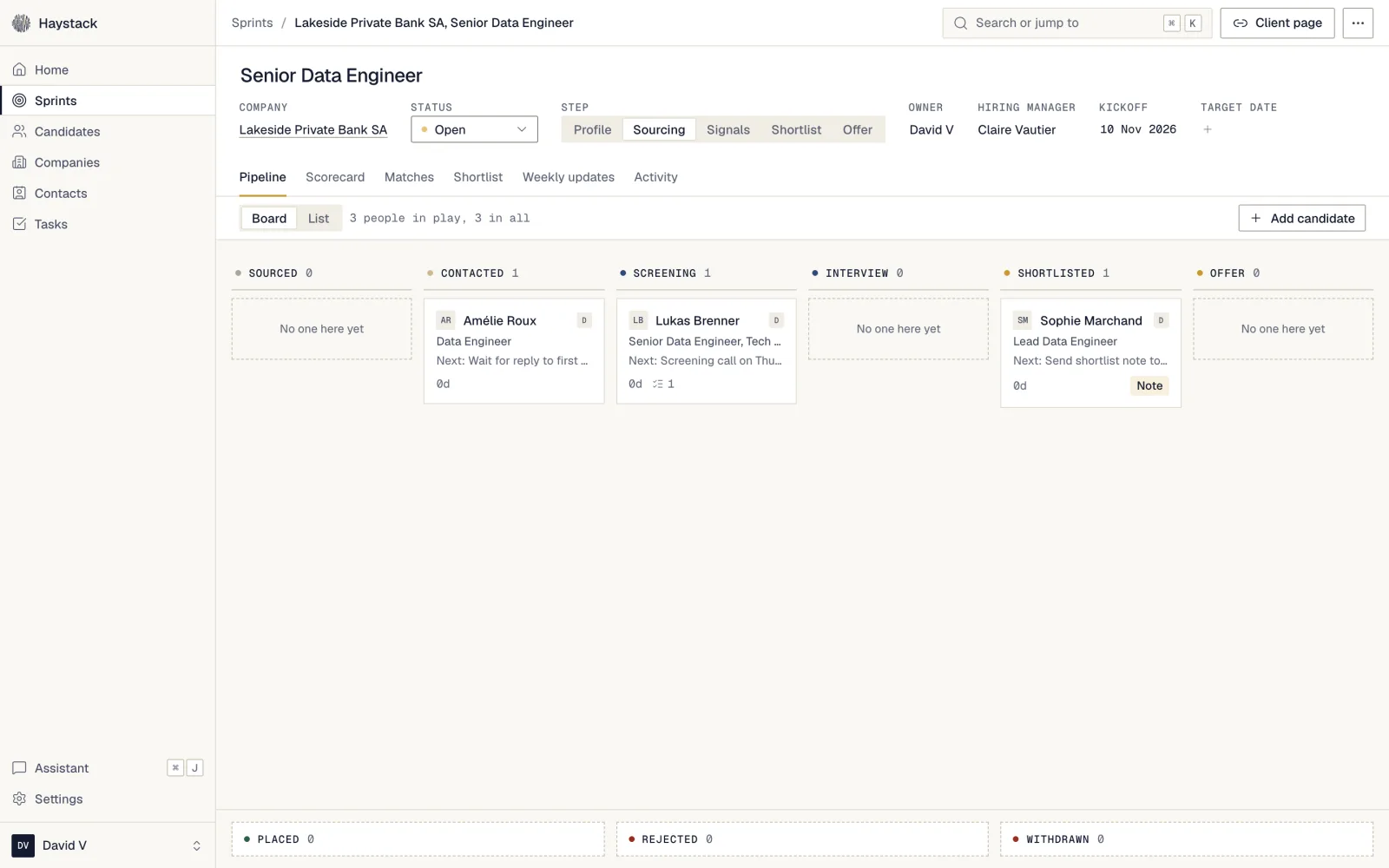
Haystack OS started in May 2025 as a much bigger recruiting platform, with branded competence files, a Chrome extension, an Outlook add-in and job board publishing. For Haystack I only used a fraction of it, so in November 2026 I rebuilt it as a lean tool for one recruiter, me, and removed most of the old features.
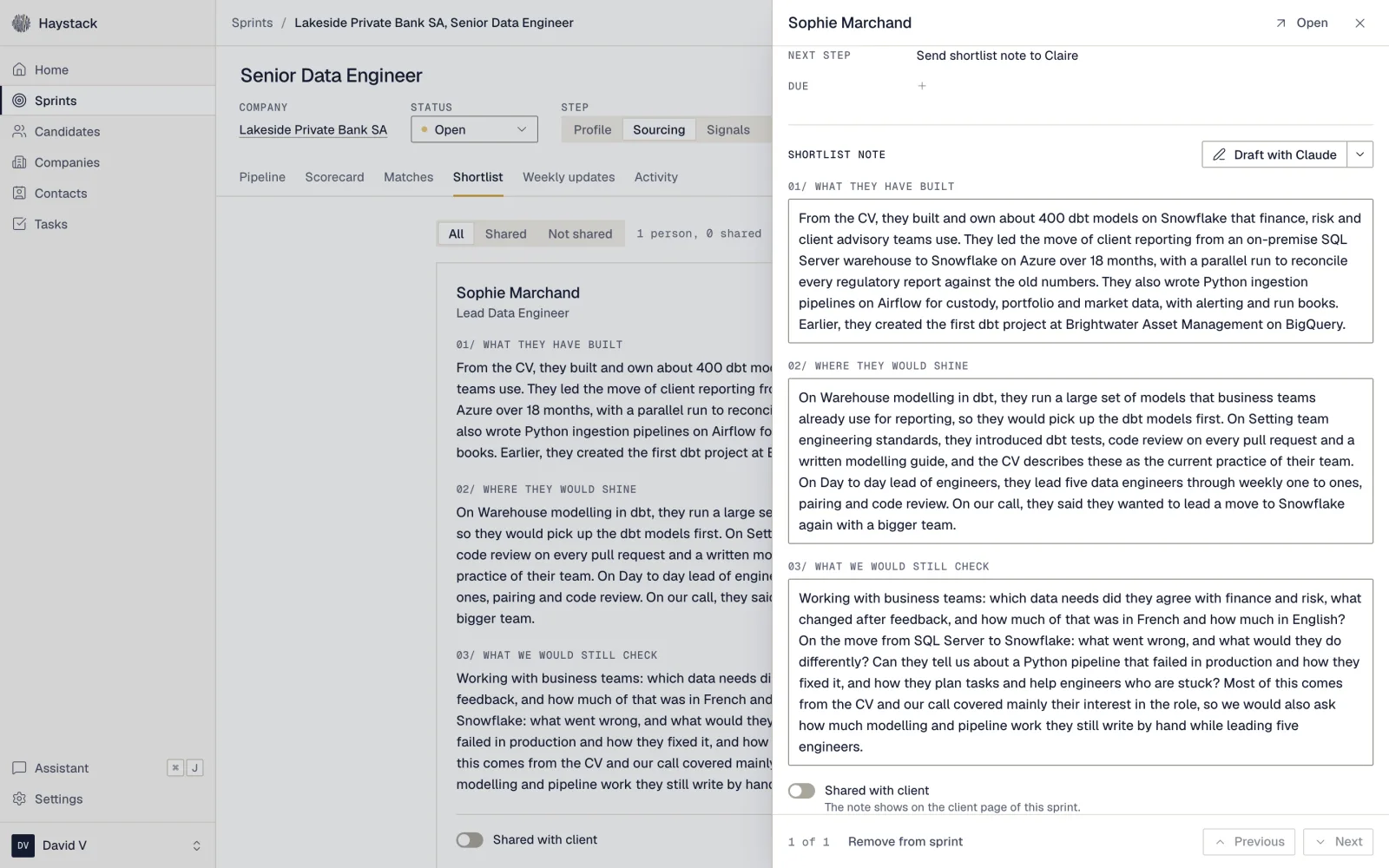
Every Claude job runs on my own Claude subscription, through a worker on my home NAS that uses the Claude Agent SDK, so there is no API key. Claude turns CVs in PDF or DOCX into profiles and writes summaries. It drafts a scorecard from a client brief, and writes shortlist notes, weekly client updates and tasks from my call notes. A guard stops a job before it could be billed to usage credits, and nothing new starts on the NAS at night.
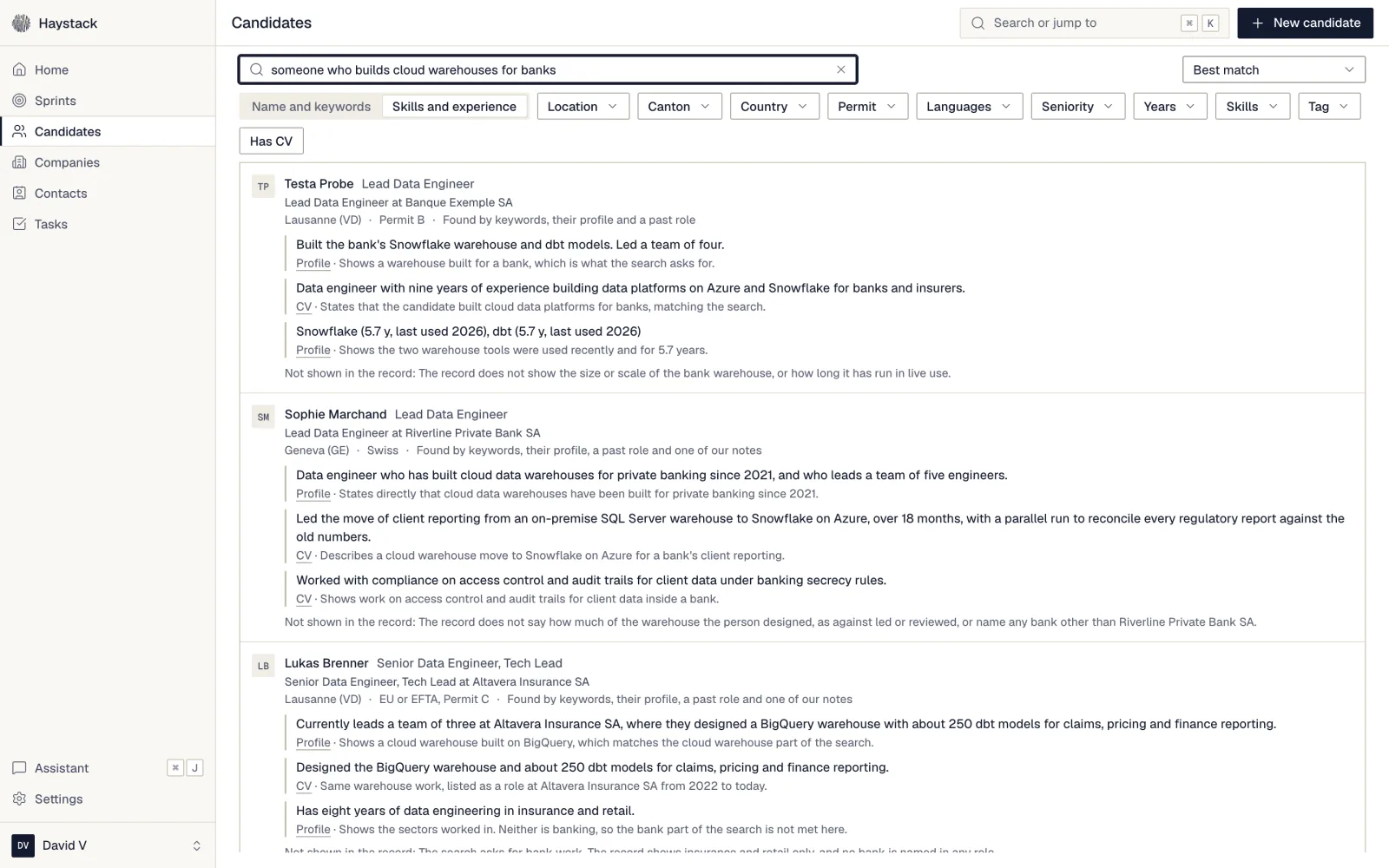
Matching checks each person against each criterion on the scorecard and quotes the evidence. There is no single overall score, and nobody is rejected automatically. Search mixes Postgres full-text search with pgvector, Voyage embeddings and reranking, with filters for location and work permit.
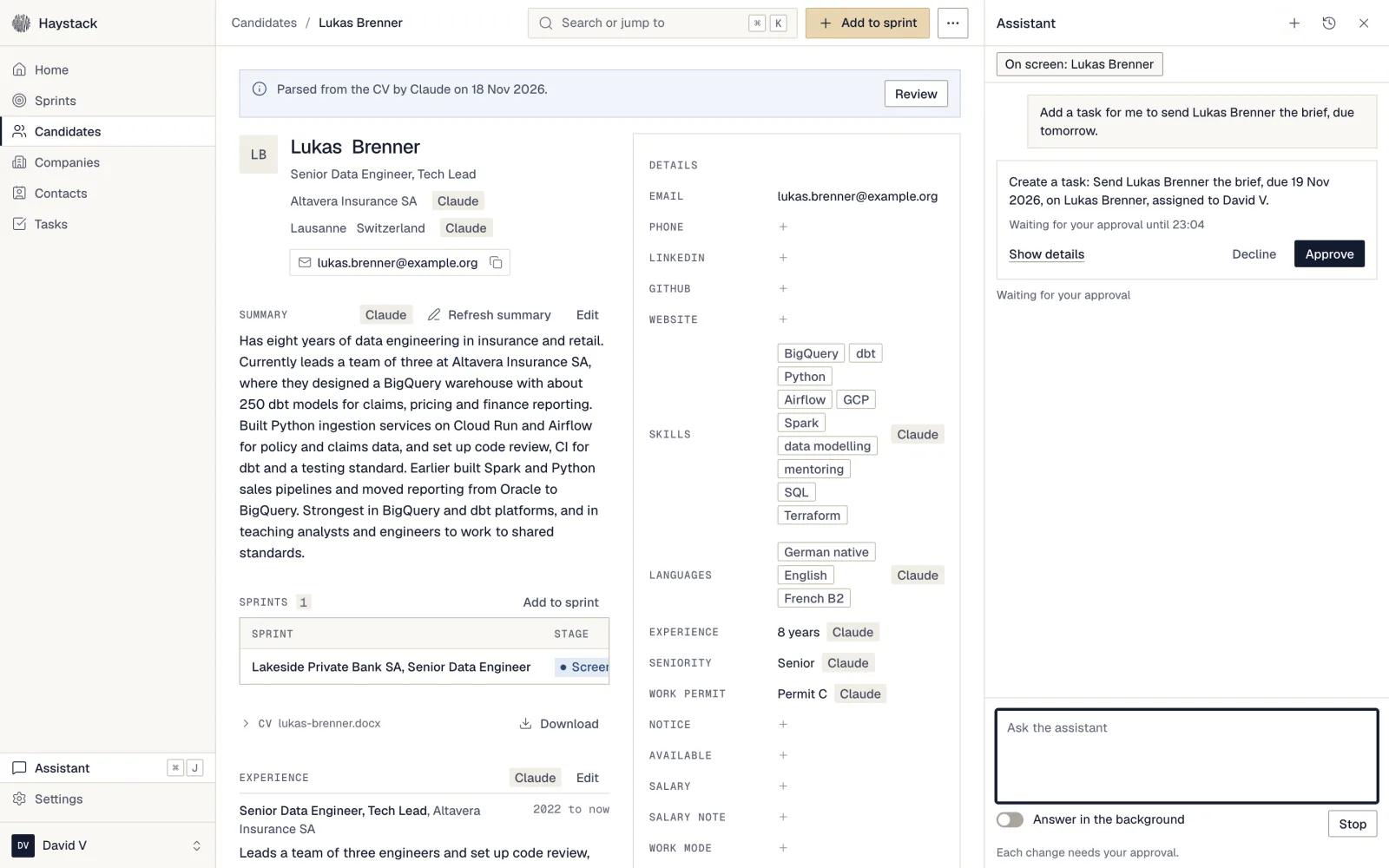
An assistant inside the app reads the records and proposes changes, and I approve them one by one. Outside the app, a full MCP server with 51 tools lets Claude read and write too, with personal tokens scoped to read, write, share or destroy, and OAuth sign-in for claude.ai through Clerk. It is private and I am its only user.
Screens
Every person, company and CV in these screens is made-up demo data.
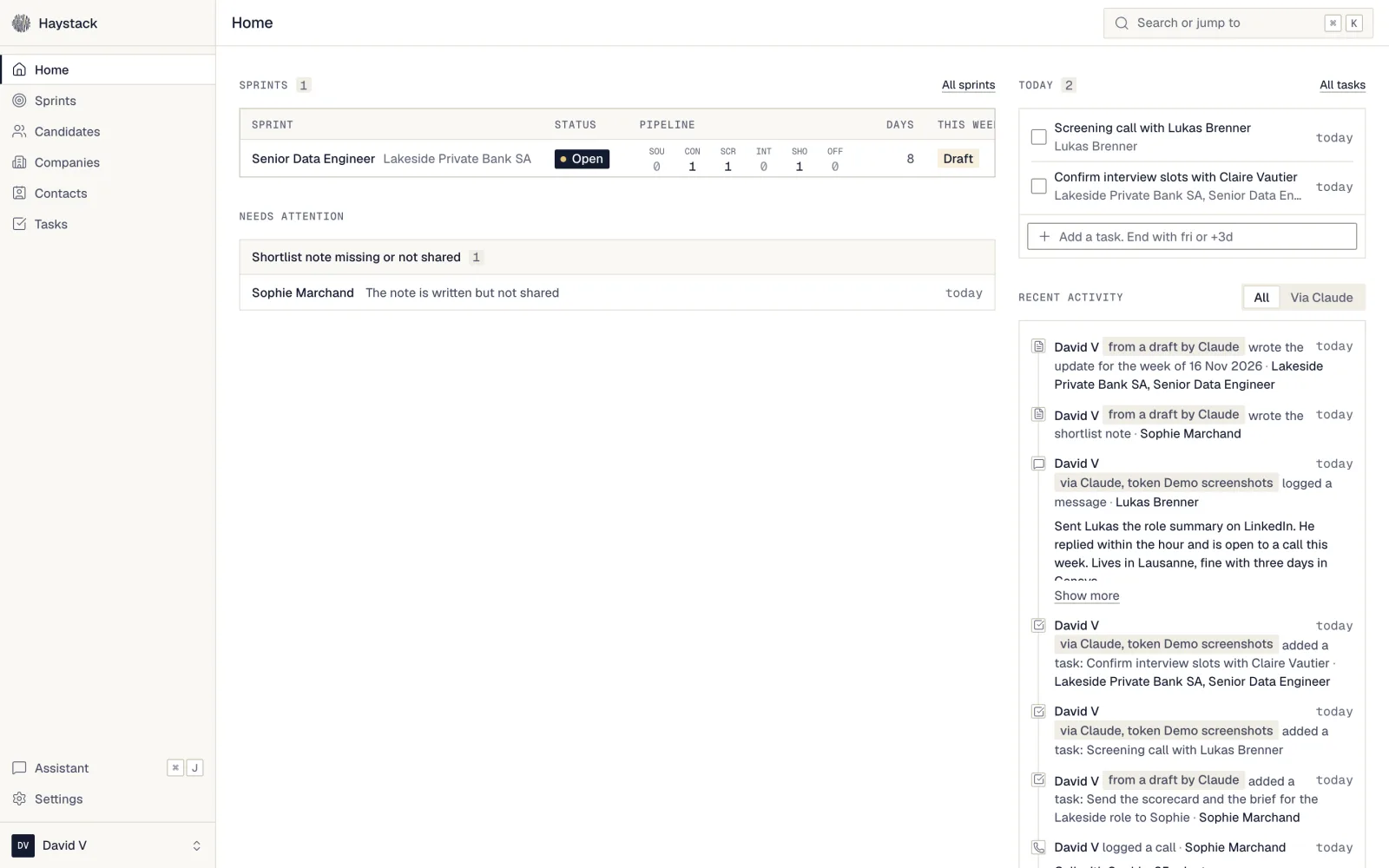
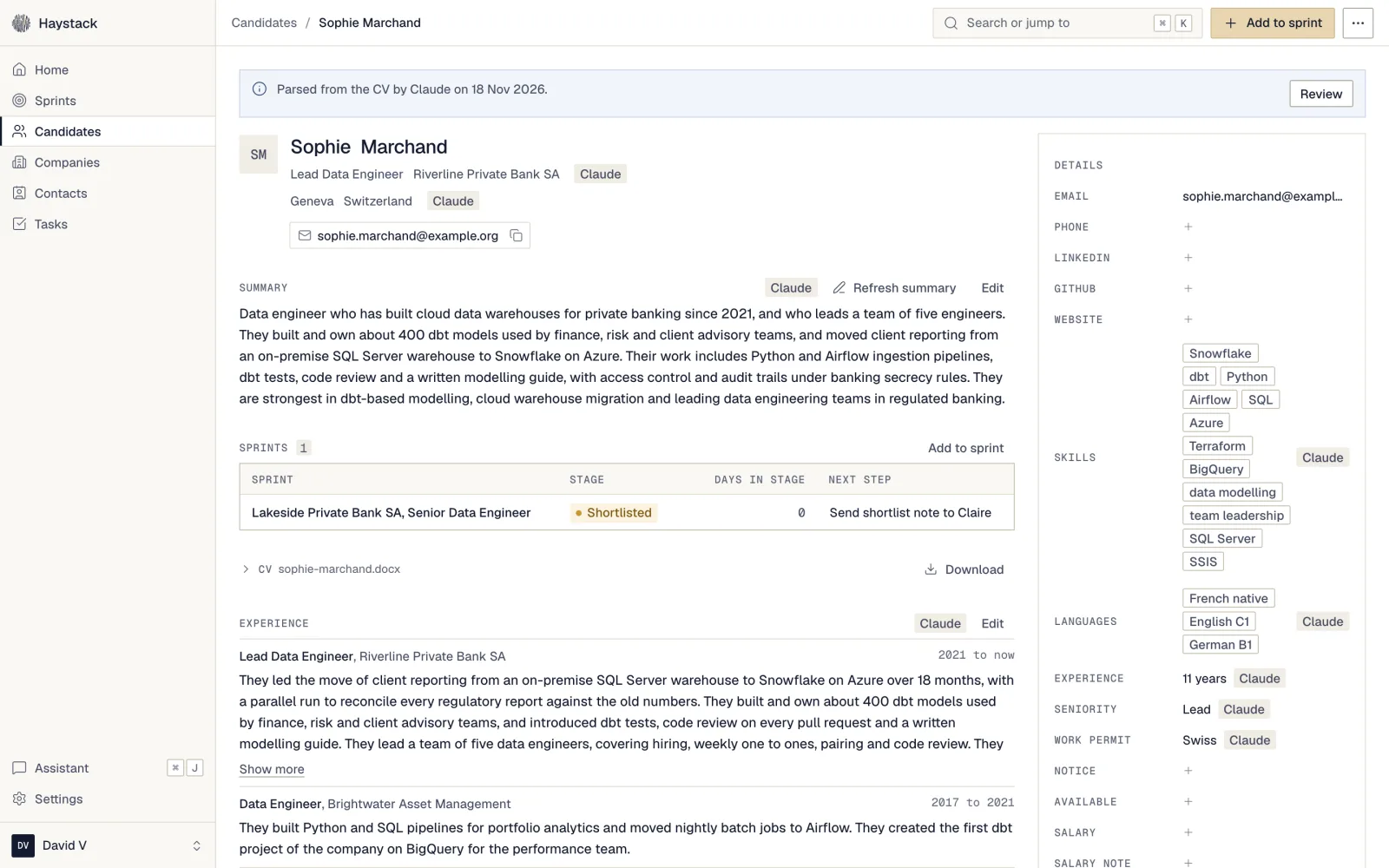
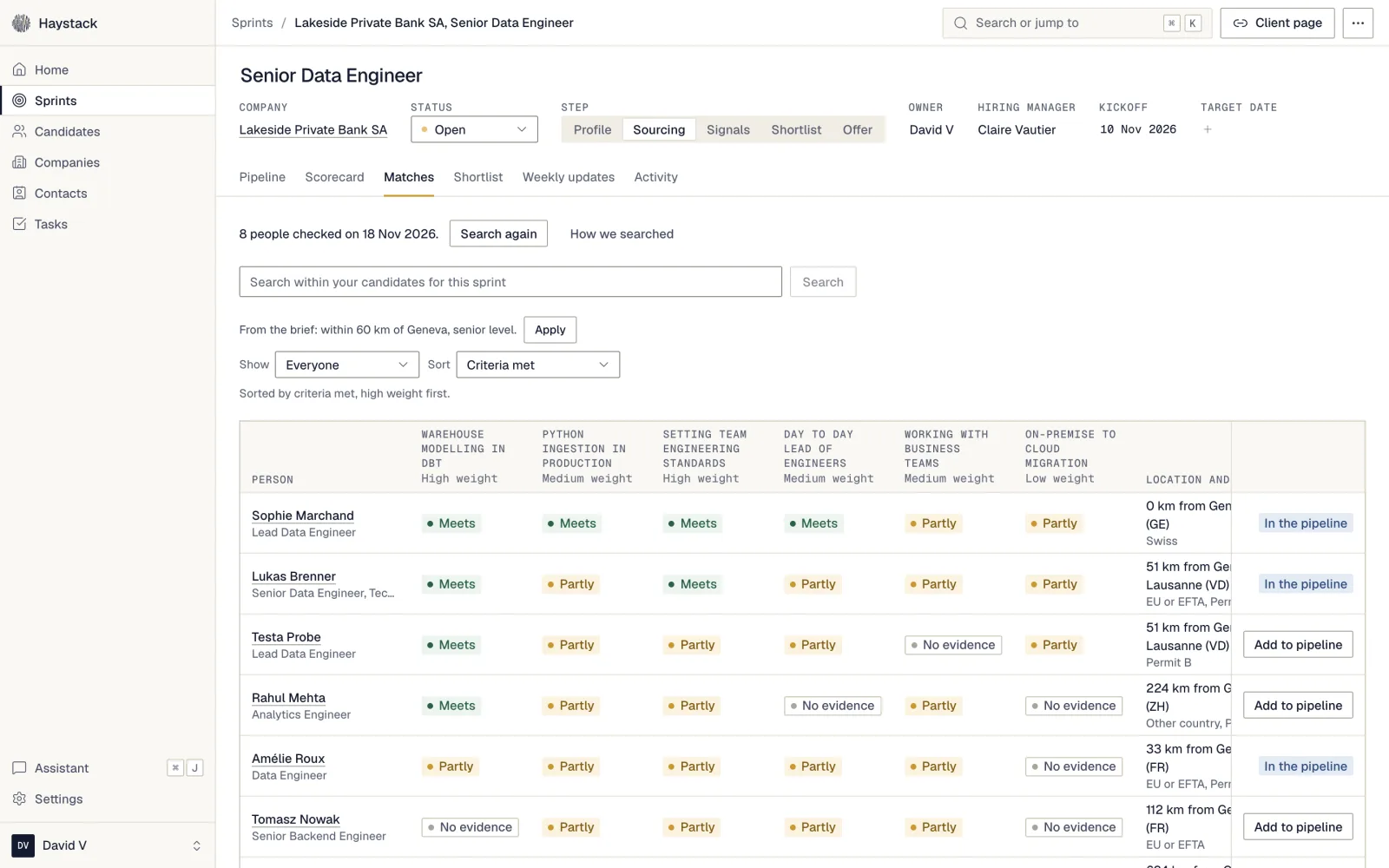
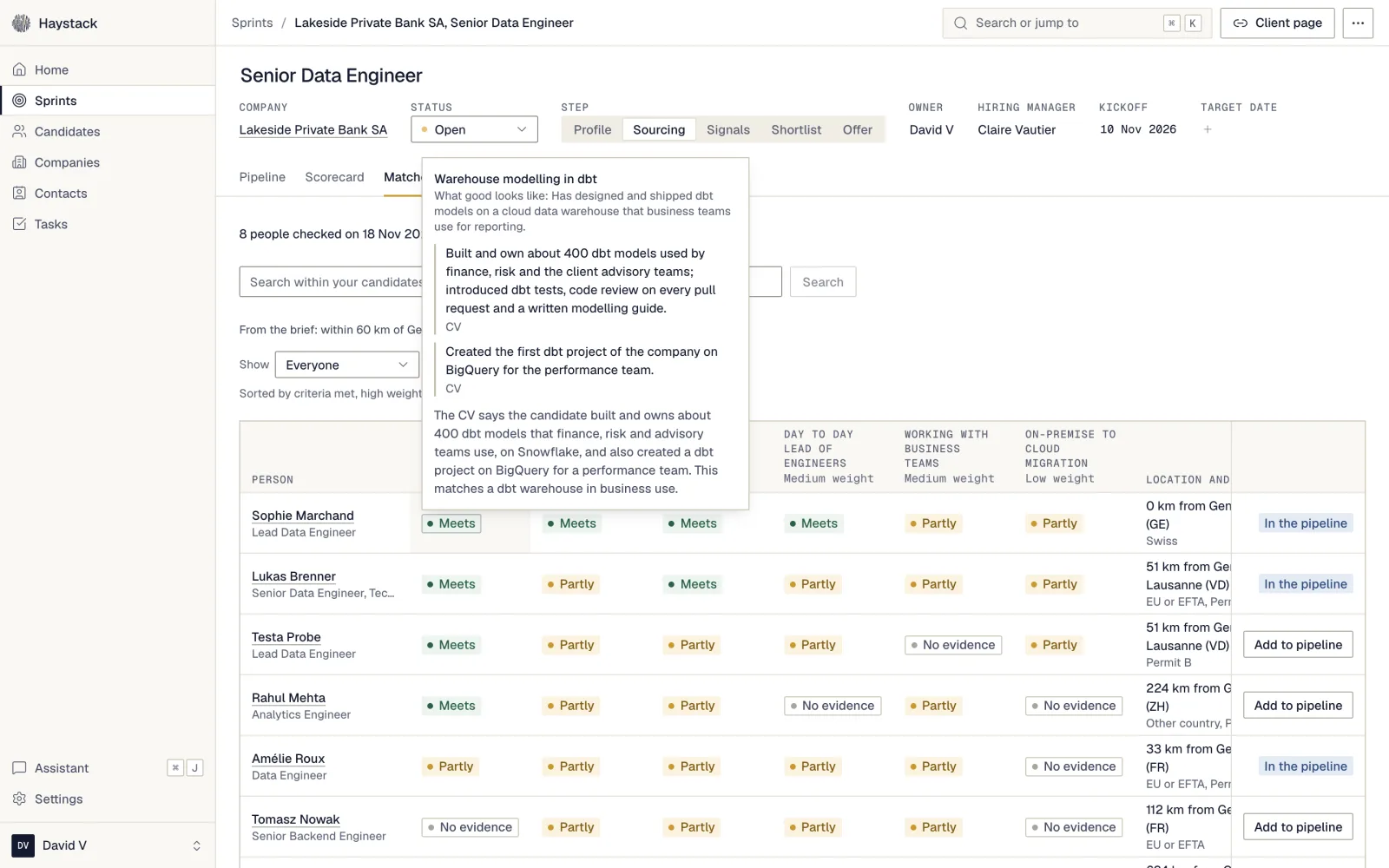
What was built
- Claude jobs run on my own subscription through a worker on my NAS, with no API key
- CVs in PDF and DOCX parsed into profiles, with summaries
- Scorecards drafted from a client brief, plus shortlist notes and weekly client updates
- Matching per scorecard criterion with quoted evidence, no overall score and no automatic rejection
- Hybrid search: Postgres full-text and pgvector with Voyage embeddings and reranking
- An in-app assistant whose changes I approve one by one
- A read and write MCP server with 51 tools, scoped tokens and OAuth sign-in for claude.ai
Stack
- Next.js
- React
- TypeScript
- Tailwind CSS
- Prisma
- PostgreSQL (Neon) + pgvector
- Clerk
- Vercel Blob
- Vercel
- Claude Agent SDK
- Voyage AI
- Resend
- MCP
- Vitest
Themes
AI agents
I build agents that do real work: answer mail, make a phone call, drive a camera, sort a photo library or run a whole build. I use whichever models fit the job: Claude, OpenAI, Gemini, open models and plenty of plain code.
MCP and tool use
I use the Model Context Protocol to connect AI assistants to real things: a camera, a photo library, my own archive and Haystack OS, my recruiting tool. I keep most servers small and read-only where that matters, and where an assistant can write, its token is scoped to what it needs.
Retrieval and grounding
I want models to answer from the original records, so they read them when the question is asked. I measure recall against real questions. In Lodestar, a camera setting only counts once the camera reads it back.
Ask before acting
For actions like sending, paying, deleting or taking a photo, my apps wait for a tap from the user. When the AI changes something, you see the change and the reason for it, and where I can, there's an Undo button.
Self-hosting and data sovereignty
My own data stays on a NAS at home, behind a tunnel. Each Neonduck customer gets their own isolated server, and if they delete the account, the server is deleted too.
Tech people
A lot of my work is about people in tech. Haystack is my tech recruitment agency, and Haystack OS is the ATS and CRM I built to run it.
Connected work
- HaystackA tech recruitment agency in Geneva that finds the right engineer, data or AI person.
- LodestarAn iPhone and iPad app that sets up a Sony camera from one sentence and takes the shot.
- NeonduckA personal AI assistant that answers mail, looks up trains, fills Swiss shopping baskets and can even make calls.